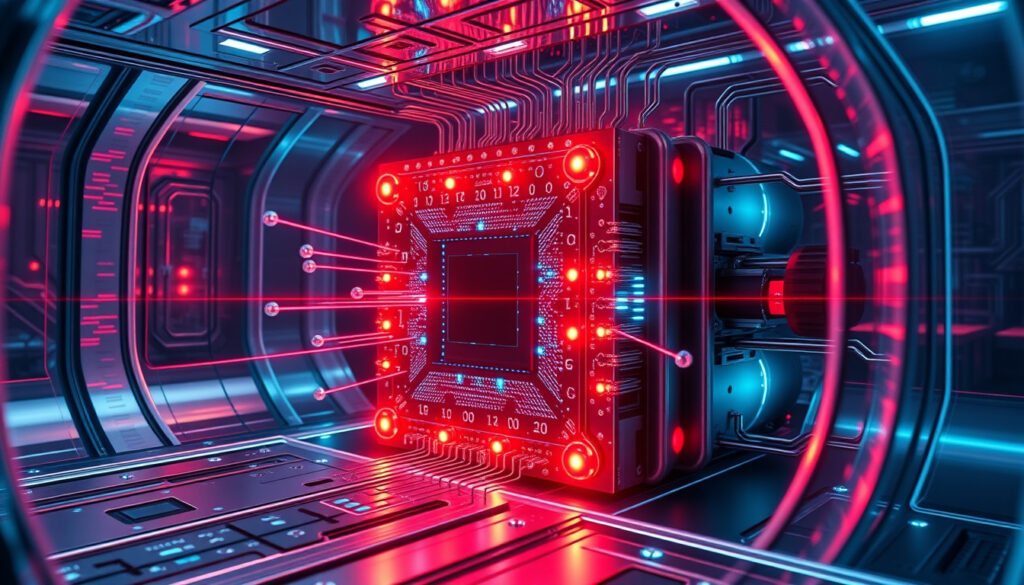
What Is Quantum Computing – How It Works and Key Applications
What Is Quantum Computing?
Quantum computing represents a fundamentally different approach to information processing. Instead of using classical bits that exist as either 0 or 1, quantum systems harness the strange properties of physics at the atomic level to perform calculations that would be impossible for ordinary computers.
The technology remains largely in the experimental stage, with major technology companies and governments investing billions of dollars annually in research and development. Understanding the basic concepts behind quantum computing provides insight into what many experts consider the next major revolution in computation.
This article explores the fundamental principles driving quantum computing, how it differs from classical approaches, real-world applications, and the significant challenges researchers continue to address.
What Is Quantum Computing?
Information processing based on quantum mechanical phenomena
Superposition allowing simultaneous multiple states
Qubit: quantum bit existing as 0, 1, or both simultaneously
Experimental; NISQ era with 50-1000+ qubits
The concept of quantum computing traces back to physicist Richard Feynman, who proposed in 1982 that quantum systems could simulate physical systems far more efficiently than classical computers. Since then, the field has evolved from theoretical physics into a global research effort involving major technology companies, academic institutions, and governments.
Key insights driving the field include:
- Exponential scaling enables n qubits to represent 2^n states simultaneously
- Current devices operate in the NISQ era without full error correction capabilities
- Hybrid quantum-classical approaches show the most promise for near-term applications
- Quantum advantages apply to specific problem types rather than general computing tasks
- Error correction demands thousands of physical qubits per logical qubit
- Global investments exceed billions annually across government and corporate programs
| Metric | Current Data |
|---|---|
| Largest announced system | 1,000+ qubits by 2025 (IBM roadmap) |
| IBM milestone (2023) | 433-qubit Osprey processor |
| Google milestone (2019) | 53-qubit supremacy demonstration |
| Physical qubits per logical qubit | 1,000–10,000 (estimated for fault tolerance) |
| Time advantage (supremacy claim) | 200 seconds vs. 10,000 years for classical |
| Gate error rates | Approximately 0.1–1% depending on platform |
| Coherence times | Microseconds to milliseconds |
| Operating temperature | Near absolute zero (~15 millikelvin) |
How Does Quantum Computing Work?
Qubits: The Foundation of Quantum Information
Classical computers process information using bits that represent either 0 or 1. Quantum computers use qubits, which exploit quantum mechanical properties to handle information in fundamentally different ways. A qubit can exist in a state of 0, 1, or any combination of both simultaneously before measurement.
Physical implementations of qubits include superconducting circuits, trapped ions, and photonic systems. Each approach has distinct trade-offs regarding coherence time, error rates, and scalability potential.
Superposition and Entanglement
Superposition allows a qubit to hold multiple potential values at once until measurement collapses the state to a definite value. The probabilities are determined by quantum wave functions, which encode the likelihood of measuring 0 or 1. When combined with entanglement, qubits can be correlated in ways that have no classical equivalent.
Entanglement creates correlations between qubits where the state of one instantly influences its partners, regardless of distance. Mathematically, entangled states like Bell states cannot be factored into individual qubit states. This interconnection enables quantum parallelism, interference for amplifying correct solutions, and exponential speedup in specific algorithms.
When a qubit is measured, its wave function collapses from superposition into a definite state. Maintaining superposition requires isolation from environmental noise—vibrations, temperature fluctuations, or electromagnetic fields can cause decoherence, collapsing quantum states prematurely and introducing computational errors.
Quantum Supremacy and Its Significance
Quantum supremacy refers to a quantum computer outperforming classical systems on a specific task. Google demonstrated this capability in 2019 using a 53-qubit processor that solved a particular problem in approximately 200 seconds. According to Google, the same calculation would require classical supercomputers roughly 10,000 years to complete. Some researchers have debated whether the chosen problem represents a meaningful quantum advantage over optimized classical approaches, but the demonstration showed that quantum systems can solve certain problems faster than any classical computer.
The practical implications of quantum supremacy remain limited since the solved problem has no immediate commercial application. However, the milestone demonstrates that quantum systems can achieve computational feats beyond classical reach under specific conditions.
Quantum Computing vs. Classical Computing
Classical and quantum computers differ fundamentally in how they process information. Classical systems use deterministic bits that exist in one of two states, enabling linear scaling where each additional bit contributes exactly one unit of information. These systems have dominated computing for decades due to their reliability, scalability, and suitability for general-purpose tasks.
Quantum systems achieve exponential parallelism through superposition and entanglement. Twenty qubits can simultaneously represent over one million states, compared to just 1,000 states for 1,000 classical bits. This exponential growth makes quantum computers potentially powerful for specific computational problems.
| Aspect | Classical Computing | Quantum Computing |
|---|---|---|
| Information Unit | Bit (0 or 1) | Qubit (superposition of 0 and 1) |
| Processing Method | Sequential operations | Parallel through superposition |
| Scaling Behavior | Linear (n bits = n states) | Exponential (n qubits = 2^n states) |
| Stability | High reliability | Vulnerable to decoherence |
| Best Applications | General-purpose tasks | Narrow optimization problems |
| Algorithm Examples | Standard arithmetic, databases | Shor’s algorithm, Grover’s algorithm |
The practical distinction matters: classical computers excel at everyday applications, data processing, and reliable computation. Quantum computers promise advantages for factoring large numbers, simulating molecular interactions, and solving combinatorial optimization problems. However, quantum systems require extreme environmental control and extensive error correction overhead, making classical computers more practical for most current applications.
Applications of Quantum Computing
Researchers and companies are exploring quantum computing across several domains where the technology could potentially outperform classical approaches.
Cryptography and Security
Shor’s algorithm uses entanglement and quantum Fourier transforms to factor large integers exponentially faster than classical methods. This capability threatens widely-used RSA encryption, prompting organizations like NIST to develop post-quantum cryptographic standards designed to resist quantum attacks.
Optimization
Industries including logistics, finance, and supply chain management could benefit from quantum optimization. Quantum algorithms can explore numerous potential solutions simultaneously, potentially identifying superior configurations faster than classical approaches.
Molecular Simulation
Simulating molecular behavior at the quantum level could accelerate drug discovery and materials science. Classical computers struggle with these calculations due to exponential complexity, while quantum systems handle them naturally since molecules follow quantum physical laws.
Machine Learning
Quantum approaches to machine learning may accelerate specific pattern recognition tasks. Current hybrid models combining quantum and classical processing show promise for near-term applications while full quantum advantage remains under development.
Present-day NISQ devices already demonstrate value for quantum-classical optimization in financial risk analysis, molecular property prediction, and traffic flow optimization. These hybrid approaches use quantum processors for specialized subroutines while relying on classical systems for broader orchestration and data management.
Challenges and Future of Quantum Computing
Technical Obstacles
Decoherence represents the primary technical challenge facing quantum computing. Qubits lose coherence when exposed to environmental noise—temperature fluctuations, electromagnetic interference, or physical vibrations. Current systems maintain coherence for microseconds to milliseconds, severely limiting how long complex calculations can run before errors accumulate.
Error correction demands substantial overhead. Fault-tolerant quantum computing requires creating logical qubits from many physical qubits to detect and fix errors without destroying the underlying quantum information. Estimates suggest 1,000 to 10,000 physical qubits may be necessary to construct a single reliable logical qubit capable of sustained operation. For more information on finding the best New Balance shoes for men, click millors sabates New Balance per a home.
The Path Forward
Hybrid quantum-classical architectures represent the most promising near-term strategy. These systems combine quantum processors optimized for specific tasks with classical computers handling general computation, data preparation, and error correction management.
Fault-tolerant quantum computers capable of solving practical problems remain years away. Roadmaps from leading organizations project fault-tolerant prototypes with approximately one million physical qubits by the 2030s. The quantum internet concept envisions networks of entangled quantum systems enabling theoretically secure communication, though substantial engineering challenges remain before such networks become viable.
Current quantum processors contain tens to hundreds of qubits. Achieving the millions of qubits required for widespread practical advantage demands breakthroughs in manufacturing, materials science, and control systems that have not yet materialized. Projected timelines for scaling remain uncertain despite optimistic company announcements.
Timeline of Quantum Computing
The field has progressed from theoretical foundations to experimental systems over several decades:
- 1982: Richard Feynman proposes quantum computers for simulating physical systems at the subatomic level.
- 1994: Peter Shor develops algorithm for factoring large numbers exponentially faster than classical methods, highlighting quantum computing’s implications for cryptography.
- 2011: D-Wave releases first commercial quantum computer, marking the technology’s transition from academic research to commercial hardware.
- 2019: Google demonstrates quantum supremacy with a 53-qubit processor solving a specialized problem in 200 seconds.
- 2023: IBM unveils 433-qubit Osprey processor, advancing toward utility-scale quantum computing.
- 2025: Roadmaps project 1,000+ qubit NISQ systems approaching practical utility for specific optimization tasks.
- 2030 and beyond: Projections anticipate fault-tolerant prototypes with approximately one million physical qubits enabling error-corrected logical operations.
What We Know and What Remains Uncertain
Understanding the boundaries between established knowledge and open questions helps clarify the current state of quantum computing:
| Established Understanding | Remaining Questions |
|---|---|
| Quantum mechanics governs qubit behavior in laboratory settings | Whether fault-tolerant systems will arrive by 2030 as projected |
| Superposition and entanglement enable theoretical exponential speedup | Which physical qubit technology will scale most effectively |
| NISQ devices demonstrate quantum effects in controlled environments | When practical quantum advantage becomes commercially viable |
| Shor’s algorithm threatens current RSA encryption schemes mathematically | How quickly post-quantum cryptography will achieve widespread deployment |
| Error correction requires substantial physical qubit overhead | Whether quantum computing will transform specific industries as predicted |
Historical Context and Global Investment
Quantum computing has evolved from theoretical physics research in the early 1980s into a strategic technology sector attracting billions in annual global investment. Major players span multiple continents: IBM and Google lead hardware development in the United States, while China and European nations pursue substantial national programs.
The geopolitical dimension reflects quantum computing’s potential applications in cryptography, artificial intelligence, and defense. Strategic supremacy in quantum technology has become a matter of national interest for major economies. Export controls on quantum technologies have emerged as governments seek to manage risks associated with cryptographic capabilities.
This regulatory environment underscores the technology’s significance beyond academic research into practical economic and security implications. For those comparing measurement systems in technology contexts, the Lbs to Kg Conversion – Formula, Chart and Calculator provides useful reference material.
Expert Perspectives and Sources
“Nature isn’t classical, damn it, and if you want to make a simulation of nature, you’d better make it quantum mechanical.”
— Richard Feynman, Caltech, 1981
The scientific foundation for quantum computing draws on peer-reviewed research published in journals including Nature and arXiv, institutional studies from organizations like IBM and DOE, and ongoing academic work in quantum information science.
“Quantum computing is a rapidly emerging technology that harnesses the phenomena of quantum mechanics to deliver a huge leap forward in computation to solve certain problems.”
— IBM Quantum Team
Summary
Quantum computing represents a fundamentally different approach to information processing, leveraging quantum mechanical phenomena to solve certain problems that classical computers cannot address efficiently. Current systems operate in the experimental NISQ era, demonstrating genuine quantum effects while facing significant challenges in decoherence, error correction, and scalability. Near-term applications are emerging through hybrid quantum-classical approaches, though widespread practical advantages await fault-tolerant systems expected in the coming decade. Travelers interested in related technological concepts may find the Best Carry On Luggage – Expert Tested Top Picks 2024 a useful resource for practical technology needs.
Frequently Asked Questions
Is quantum computing real?
Yes, quantum computing exists as functioning technology. Multiple organizations have built quantum processors with dozens to hundreds of qubits. IBM provides cloud access to quantum systems, and companies like Google have demonstrated quantum supremacy on specialized problems. The technology remains experimental with significant limitations, but it operates beyond theoretical frameworks.
What is quantum supremacy?
Quantum supremacy occurs when a quantum computer solves a specific problem faster than any classical computer can, even with extensive optimization. Google claimed this milestone in 2019 with a 53-qubit processor solving a specialized problem in approximately 200 seconds. Some researchers debate whether the selected problem truly represents meaningful quantum advantage, but the demonstration showed quantum systems can outperform classical computers under certain conditions.
When will quantum computers be widely available?
Widespread availability depends on achieving fault-tolerant systems with robust error correction. Current roadmaps project 1,000+ qubit NISQ systems by 2025, with fault-tolerant prototypes potentially emerging by the 2030s. Commercial cloud access through IBM and other providers exists today, though practical advantages remain limited to specific applications.
What is a qubit?
A qubit, or quantum bit, serves as the fundamental unit of quantum information. Unlike classical bits restricted to 0 or 1, qubits exploit superposition to exist simultaneously in multiple states until measured. Physical implementations include superconducting circuits, trapped ions, and photons, each with distinct characteristics for maintaining quantum states.
Can quantum computers break encryption?
Shor’s algorithm demonstrates mathematically that quantum computers could factor the large numbers underlying RSA encryption exponentially faster than classical methods. This capability would compromise current cryptographic systems. However, practical quantum computers large enough to execute these attacks remain years away, and post-quantum cryptography standards are actively being developed to counter this threat.
What is the difference between NISQ and fault-tolerant quantum computing?
NISQ (Noisy Intermediate-Scale Quantum) devices contain 50 to over 1,000 qubits but operate without full error correction, making them susceptible to noise and decoherence. Fault-tolerant systems use many physical qubits to create stable logical qubits capable of sustained computation. Fault tolerance represents the long-term goal but requires substantial engineering advances over current NISQ technology.
More related posts
 Who Is Winning the Blue Jays Game? Game 7 Score & Odds
 Rohit Sharma: Age, Wife, Records, Retirement & 2027 Plans
 Dr. Doofenshmirtz: Voice, Backstory & Neurodivergence
 Last of Us Game – Complete Series Overview
 We tern Auto Group Review : What Cu tomer Say in 2025
 Jamie Foxx: His Health Crisis and Life Updates
 Best Free AI Chat 2025: Legal and Safe Options Compared
 Where Do I Vote? Ireland Polling Station Hours & Location Guide