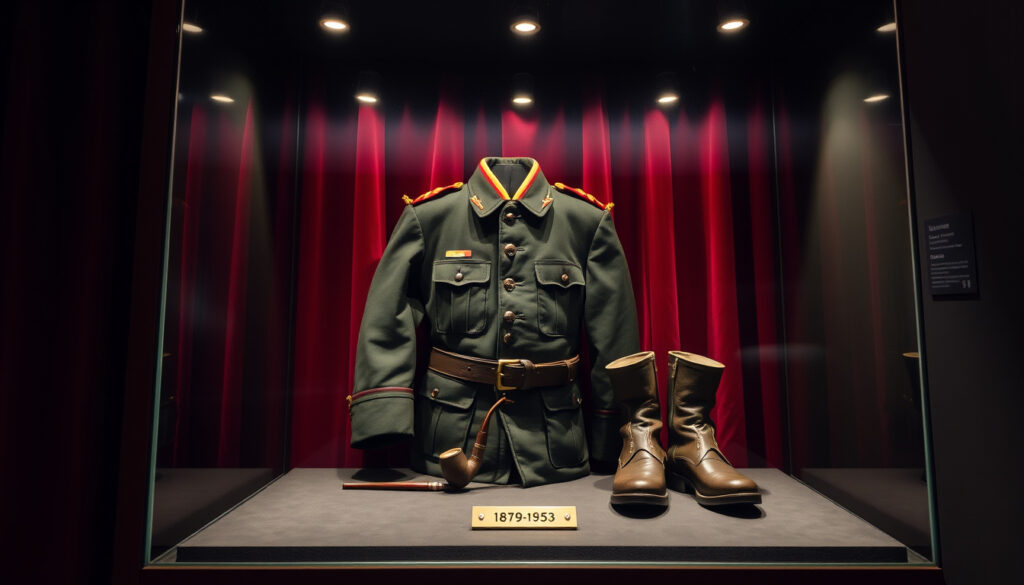
Joseph Stalin: Biography, Death, Height and Personality
Joseph Stalin provokes a visceral reaction even seven decades after his death. Born on 18 December 1878 in Gori, Georgia, he rose to become the undisputed leader of the Soviet Union from 1924 until his death in 1953, overseeing industrialization, victory in World War II, and brutal repression.
Full name: Joseph Vissarionovich Stalin ·
Born: 18 December 1878 ·
Died: 5 March 1953 ·
Height: 5 ft 4 in (1.63 m) ·
Years in power: 1924–1953
Quick snapshot
- Led the Soviet Union from 1924 to 1953 (Wikipedia)
- Oversaw rapid industrialization via Five-Year Plans (Britannica)
- Ordered the Great Purge of the 1930s (History.com)
- Exact number of deaths during his rule remains disputed (BBC)
- His true motivations behind certain policy shifts (Alpha History)
- Whether his paranoia was genuine or a strategic posture (Military History Matters)
- 1928: Launched first Five-Year Plan (Britannica)
- 1941: Hitler invaded the Soviet Union (National WWII Museum)
- 1953: Stalin died of a stroke (Wikipedia)
- Russian archives continue releasing Soviet-era documents (The Guardian)
- Historical reassessment of Stalin’s wartime decisions ongoing (Warfare History Network)
- Comparisons between Stalin and modern authoritarian leaders persist (Montreal Press)
The following table summarizes key biographical data.
| Attribute | Value |
|---|---|
| Full name | Joseph Vissarionovich Stalin |
| Born | 18 December 1878 |
| Died | 5 March 1953 |
| Nationality | Soviet |
| Political party | Communist Party of the Soviet Union |
| Height | 5 ft 4 in (1.63 m) |
| Years in power | 1924–1953 |
Who was Joseph Stalin and why was he important?
Joseph Vissarionovich Stalin was the dictator who turned the Soviet Union from a backward agrarian state into a global military superpower. Born to a cobbler and a washerwoman in Gori, Georgia, he studied at the Tiflis Theological Seminary before joining the Bolshevik revolutionary movement. By 1922, he had risen to the position of General Secretary of the Communist Party — a role he used to consolidate absolute power after Vladimir Lenin’s death. His importance stems from three achievements: leading the USSR to victory in World War II, forcing through rapid industrialization via the Five-Year Plans, and establishing one of the most comprehensive totalitarian systems in modern history.
What did Joseph Stalin do?
Stalin’s actions reshaped the Soviet Union and the world. Between 1928 and 1940, his first Five-Year Plans drove industrial output up by 200% in some sectors, but at a staggering human cost. Collectivization of agriculture led to the Holodomor famine in Ukraine, which killed an estimated 3–5 million people. The Great Purge of 1936–1938 saw roughly 1.5 million people arrested; about 700,000 were executed. During World War II, Stalin took personal command of the Red Army and oversaw the decisive victories at Stalingrad and Berlin. After the war, he installed communist governments across Eastern Europe, setting the stage for the Cold War.
Stalin industrialized a nation with a plow and left it with nuclear weapons — but the cost was measured in millions of lives. The man who defeated Hitler also created one of the most repressive regimes in history.
The implication: Stalin’s rise from obscurity to absolute power was marked by both achievement and atrocity.
Why was Joseph Stalin so popular?
Stalin enjoyed genuine popularity among many Soviet citizens, a fact that puzzles historians who focus only on his brutality. Three factors drove this affection: victory in the Great Patriotic War, rapid modernization, and an elaborate cult of personality. After defeating Nazi Germany in 1945, Stalin was viewed by millions as the father of the nation who had saved them from destruction. The industrialization campaigns turned a peasant society into an industrial power, creating jobs, infrastructure, and a sense of national purpose. Propaganda portrayed Stalin as a heroic, infallible leader — and for many who had known nothing but poverty, the narrative stuck.
What made Stalin a hero to many Soviet citizens?
The victory over Hitler’s Germany in 1945 was the cornerstone of Stalin’s popularity. Soviet forces suffered more than 27 million casualties, but they defeated the Wehrmacht and captured Berlin. Stalin personally accepted the German surrender and was hailed as a military genius. The postwar reconstruction of cities like Stalingrad and Kiev reinforced his image as a builder. At the same time, the secret police ensured that dissent was invisible: anyone who openly criticized Stalin disappeared. Popularity, in other words, was both earned through victory and enforced through fear.
The blend of genuine wartime gratitude and organized terror created a loyalty feedback loop. For citizens who lost family in the war, Stalin was the man who avenged them. For those who lost family in the purges, silence was survival. Both responses kept him in power.
What this means: Popularity and fear were two sides of the same coin.
What was Stalin like as a person?
Stalin’s personality has been dissected by biographers for decades, and the portrait that emerges is deeply contradictory. He was intelligent and well-read — his personal library in the Kremlin contained thousands of books on history, military strategy, and linguistics. He was also paranoid, cruel, and deeply suspicious, ordering the execution of close associates on flimsy pretexts. He lived modestly in many respects, wearing simple tunics and sleeping in a small room at his Kuntsevo dacha, yet he also enjoyed lavish banquets and Georgian wine. He could be charming and soft-spoken in private meetings, then sign death lists of hundreds of people hours later.
What were Stalin’s character traits?
Contemporary accounts describe Stalin as methodical, patient, and ruthless. He rarely raised his voice, preferring to manipulate people through silence and carefully timed interventions. He was deeply insecure about his physical appearance: he stood about 5 feet 4 inches (1.63 meters), had a shorter left arm due to a childhood carriage accident, and his face was pockmarked from smallpox. Stalin reportedly disliked photographers and had his official portraits retouched to make him look taller and more imposing. He also had a sharp, often cruel sense of humor — at dinner parties he would mock guests and watch their reactions with cold amusement.
- Intelligent and widely read, with a photographic memory for names and details (Britannica)
- Paranoid: trusted almost no one, rotated his security staff constantly (History.com)
- Ruthlessly pragmatic: shifted alliances and policies without sentiment (Alpha History)
- Physically short and self-conscious about it (Military History Matters)
The catch: The man behind the image was far more complex than the propaganda.
Did Stalin support LGBTQ rights?
No — Stalin’s regime criminalized homosexuality and persecuted LGBTQ people with the same severity it applied to other “deviant” groups. Before Stalin, the Bolshevik government had legalized homosexuality in 1917, making the Soviet Union one of the first European states to do so. That changed in 1934, when Stalin personally approved an amendment to the criminal code that recriminalized consensual same-sex acts. Article 121 of the Soviet penal code punished male homosexuality with up to five years of hard labor. Lesbianism was not explicitly criminalized but was policed through psychiatric commitment and social ostracism.
The law remained on the books until 1993. During Stalin’s purges, gay men were arrested alongside political prisoners, intellectuals, and ethnic minorities. The regime’s official position was that homosexuality was a symptom of bourgeois decadence and had no place in socialist society. Stalin’s own views were consistent with the broader Russian and Georgian cultural conservatism of his era, but his government’s enforcement was notably harsher than in many other European countries of the time.
The implication: Stalin’s legacy on human rights includes a reversal of early Soviet tolerance.
How did Stalin and Hitler view each other?
Stalin and Hitler were ideological enemies who shared a grudging mutual respect for each other’s ruthlessness. They never met face to face, but their relationship evolved from an uneasy pact to total war. In August 1939, the two dictators signed the Molotov–Ribbentrop Pact, a non-aggression treaty that carved up Eastern Europe between them. Stalin trusted Hitler enough to ignore warnings of the German invasion in 1941 — a miscalculation that nearly cost him the war. After that, Stalin pursued a single goal: the destruction of Hitler and Nazi Germany.
How did Stalin react to Hitler’s death?
When Hitler committed suicide on 30 April 1945, Stalin’s reaction was surprisingly restrained. According to Soviet accounts, Stalin was informed of Hitler’s death on 1 May and responded with what one aide called “quiet satisfaction.” Privately, Stalin had expected Hitler to be captured alive and put on trial. He reportedly told associates that Hitler’s suicide was a “coward’s exit” and that the Nazi leader should have faced judgment in Moscow. Stalin also suspected — without evidence — that Hitler might have faked his death and escaped, and ordered the Red Army to confirm the body through dental records and witness testimony.
What was Hitler’s opinion of Stalin?
Hitler’s view of Stalin was a tangle of contempt and admiration. In private conversations recorded in the Führerbunker, Hitler called Stalin “one of the most extraordinary figures in world history” and admired his “brutal determination.” But he also despised communism and believed Stalin represented “Jewish-Bolshevik” subhumanity. Hitler’s invasion of the Soviet Union in 1941 was driven partly by ideological hatred and partly by a strategic belief that Stalin’s regime would collapse quickly. When it did not, Hitler’s respect for Stalin grew grudgingly — but never enough to prevent the genocidal war that followed.
- Stalin was shocked by Hitler’s death, expecting a negotiated surrender (Warfare History Network)
- Hitler admired Stalin’s brutality but despised communism ideologically (Alpha History)
- They signed the Molotov–Ribbentrop Pact in 1939 (Britannica)
- Both came from humble backgrounds and built totalitarian states (Alpha History)
The pattern: Their mutual respect and contempt fueled a devastating war.
The Stalin timeline
The timeline below highlights key events in Stalin’s life.
| Year | Event |
|---|---|
| 18 December 1878 | Born in Gori, Russian Empire (Wikipedia) |
| 1917 | Played key role in the Bolshevik Revolution (Britannica) |
| 1922 | Appointed General Secretary of the Communist Party (History.com) |
| 1928 | Launched the first Five-Year Plan for industrialization (Britannica) |
| 1930s | Great Purge: millions killed or imprisoned (BBC) |
| 1941–1945 | Led the Soviet Union to victory in World War II (National WWII Museum) |
| 5 March 1953 | Died of a stroke in Moscow (Wikipedia) |
What we know for sure — and what remains murky
Confirmed facts
- Stalin was born in 1878 and died in 1953 (Wikipedia)
- He was General Secretary of the Communist Party from 1922 (Britannica)
- He ordered the Great Purge of the 1930s (History.com)
- The Soviet Union won World War II under his leadership (National WWII Museum)
- He recriminalized homosexuality in 1934 (BBC)
What remains unclear
- Exact total number of deaths attributable to his policies — estimates range from 3 million to over 20 million (BBC)
- Whether Stalin’s paranoia was a genuine psychological condition or a calculated leadership tool (Military History Matters)
- His precise thinking during key wartime decisions, since he left few personal writings (Alpha History)
- Stalin’s exact height is disputed; sources range from 5’4″ to 5’7″ (Military History Matters)
- The authenticity of the quote “Death solves all problems” attributed to Stalin is uncertain (Britannica)
In their own words
Stalin took over a country with a plow and left it with atomic weapons.
— Winston Churchill, former British Prime Minister
Death solves all problems — no man, no problem.
— Attributed to Joseph Stalin
Stalin’s cult of personality led to violations of Leninist principles and grave abuses of power.
— Nikita Khrushchev, Soviet leader, in his 1956 “Secret Speech” (The Guardian)
Summary
Joseph Stalin was a man of extraordinary contradictions: a revolutionary who became a tyrant, a victor who starved his own people, a leader who defeated fascism and built a police state. His legacy resists easy moral accounting. For readers trying to understand the 20th century, the lesson is uncomfortable but unavoidable: the same qualities that won wars — ruthlessness, paranoia, strategic patience — also produced the gulag and the purges. For anyone studying power, Stalin remains the ultimate case study in what happens when one person holds absolute control over a modern state.
imdb.com, the-past.com, reddit.com, reddit.com, nationalgeographic.com, youtube.com, winstonchurchill.hillsdale.edu, mrrangel.weebly.com
For a more detailed look at Stalin’s biography and legacy, readers can explore Stalins biography and legacy which covers his height, death, and controversial rule.
Frequently asked questions
What was Stalin’s religion?
Stalin was raised in the Georgian Orthodox Church and studied at the Tiflis Theological Seminary as a young man. He became an atheist and Marxist revolutionary, and as leader of the Soviet Union, he enforced state atheism, suppressed religious institutions, and persecuted clergy. However, some accounts suggest he maintained a private, superstitious interest in certain Orthodox rituals.
How tall was Joseph Stalin?
Historical records place Stalin’s height at approximately 5 feet 4 inches (1.63 meters), though different sources give slightly varying figures. His short stature contributed to well-documented insecurities about his physical appearance, and official portraits were routinely retouched to make him look taller.
What caused Joseph Stalin’s death?
Stalin died on 5 March 1953 from a cerebral hemorrhage — a stroke — at his Kuntsevo dacha outside Moscow. He had been in declining health for years, with high blood pressure and arteriosclerosis. The stroke went untreated for several hours because his guards were too afraid to disturb him, and medical help arrived only after a delay.
How many children did Stalin have?
Stalin had three known children: a son, Yakov Dzhugashvili, who died in a German prisoner-of-war camp during World War II; another son, Vasily Stalin, who became a Soviet air force officer and died of alcoholism; and a daughter, Svetlana Alliluyeva, who defected to the United States in 1967 and wrote memoirs about her father.
Was Stalin a communist or a dictator?
Stalin was both. He was the leader of the Communist Party of the Soviet Union and governed under a communist ideology, but his rule functioned as a personal dictatorship. He had absolute control over the party, the military, the secret police, and the economy. Political dissent was not tolerated, and elections were not competitive.
What was Stalin’s role in World War II?
Stalin served as the supreme commander of the Soviet armed forces during the war. He took personal control of military strategy, oversaw the defense of Moscow and Stalingrad, and represented the USSR at the Tehran, Yalta, and Potsdam conferences with Churchill and Roosevelt. His leadership was decisive in the Soviet victory over Nazi Germany.
Did Stalin ever meet Hitler?
No, Stalin and Hitler never met in person. Their only direct interaction was through diplomatic channels, most notably the Molotov–Ribbentrop Pact of 1939. They communicated through letters and diplomatic envoys but never sat in the same room. This absence of a personal meeting contrasts with Stalin’s extensive face-to-face diplomacy with Churchill and Roosevelt during the war.
What was Stalin’s relationship with Churchill like?
Stalin and Churchill formed an uneasy but functional alliance during World War II, driven by the shared goal of defeating Hitler. Churchill described Stalin as a “tough old Bolshevik” who could be charming in private but ruthless in negotiation. Their relationship soured after the war as Churchill warned of an “Iron Curtain” descending across Europe.
Related reading: Mojtaba Khamenei: Biography of Iran’s New Supreme Leader · Tulsi Gabbard: Biography, Military Service, Controversies
More related posts
 Cyndi Lauper: Biography, Psoriasis Battle, and Husband
 Pompompurin: Boy or Girl? Dog or Bear? Official Facts
 How to Make a QR Code: Free Generators & Safety Tips
 Hania Amir: Age, Dramas, and Relationship Rumors in 2024
 Festival Juste Pour Rire 2025 – Dates, Lineup and Tickets
 Muggsy Bogues: Height, Dunk, Stats & Jordan’s Take
 Getafe – Real Madrid: Composition, Lineups & Team News
 Spider-Man 2026: Brand New Day, All 8 Movies & More