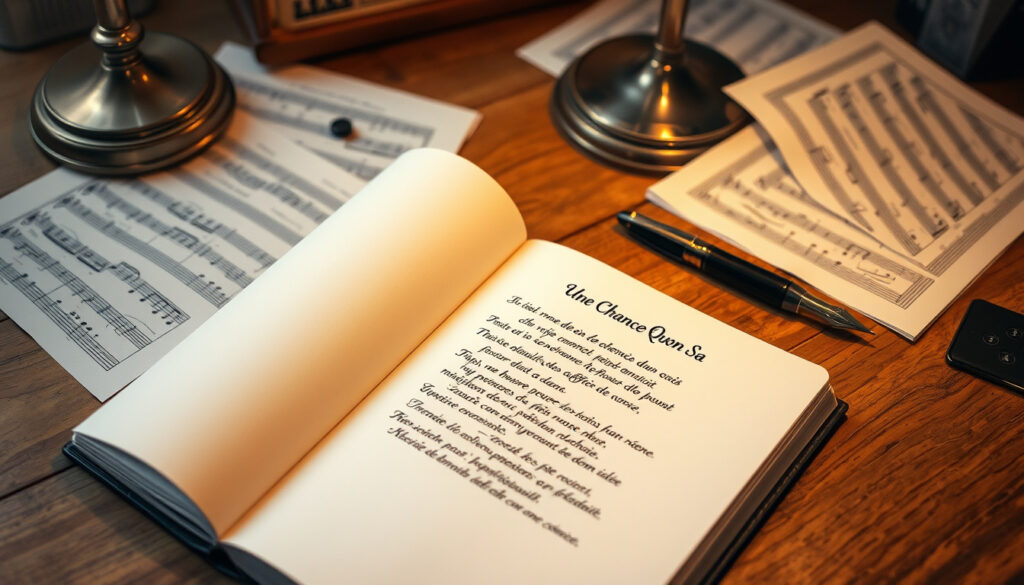
Une Chance Qu’on S’a: Meaning, Lyrics, Writers, Covers
“Une chance qu’on s’a” is a Quebecois song that refuses to stay quiet—one that turns ordinary French into a lifelong shield against loneliness. Written by Jean-Pierre Ferland and set to music by Alain Leblanc, it first appeared on Ferland’s 1995 album “Écoute pas ça” and has quietly become essential at memorials where words fail.
Original Artist: Jean-Pierre Ferland · Co-Writer: Alain Leblanc · Release Year: 1995 · Notable Duet: Céline Dion · Album: Écoute pas ça
Quick snapshot
- Written by Jean-Pierre Ferland (lyrics) and Alain Leblanc (music) (Letras.mus.br)
- Original release February 1, 1995 on “Écoute pas ça” (YouTube)
- Duet with Céline Dion on “Sans attendre” (2012) (Wikipedia)
- Exact funeral performance details remain undocumented
- Limited public records on specific tribute performances
- Full list of covers beyond Dion version not publicly verified
- Song continues appearing in Quebec memorial tributes
- Growing recognition as a funeral-appropriate anthem
- Ongoing use in SOCAN member celebrations of Ferland’s legacy
The table below consolidates the verified facts about the song, its creators, and its commercial history.
| Fact | Detail |
|---|---|
| Original Release | 1995 on Écoute pas ça |
| Writers | Jean-Pierre Ferland, Alain Leblanc |
| Genre | Quebecois pop |
| Notable Cover | Céline Dion 2012 duet |
| Publishing | Sony ATV, Avenue Éditorial, Les Éditions Renlec |
| Ferland’s Nickname | Le petit roi (tribute name) |
Who Wrote Une Chance Qu’on S’a?
The songwriting credits on “Une chance qu’on s’a” represent a genuine collaboration between two Quebec music figures. Jean-Pierre Ferland wrote the lyrics, while Alain Leblanc composed the music—a partnership that gave the song its distinctive character. This division of labor is notable because Ferland, already an established singer-songwriter, chose to bring in Leblanc specifically for the musical arrangement and composition.
Role of Alain Leblanc
Alain Leblanc’s contribution as composer is central to understanding the song’s emotional architecture. While Ferland’s lyrics carry the narrative weight—the protective promises, the tender nicknames, the declarations of eternal devotion—Leblanc’s melody provides the gentle urgency that makes those words land so effectively. According to L’envers des jours (music analysis blog), the collaboration represents one of Ferland’s most successful partnerships in terms of how the music amplifies the lyrical message.
For Quebec music historians, the Ferland-Leblanc partnership illustrates how collaborative songwriting can elevate a simple love song into something that resonates across generations. The song’s continued relevance nearly three decades later speaks to the strength of that creative partnership.
What is the Meaning of Une Chance Qu’on S’a?
At its core, “Une chance qu’on s’a” is a song about the irreducible comfort of having someone who loves you back. The title itself translates roughly to “A chance that we have each other” or, more colloquially, “Thank God we have each other.” This isn’t abstract romantic sentiment—it’s a specific, almost defiant statement of mutual possession and protection.
Lyrics interpretation
The song unfolds through a series of images that parents will recognize immediately. The child calls the parent “mon p’tit loup” (my little wolf), while the parent responds with “mon bon chat” (my good cat)—endearing terms that reverse the usual power dynamic in touching ways. As documented by Paroles.net (official lyrics repository), the song’s most famous lines contain this protective promise: “J’suis pas très grand, pas très fort, mais que personne vienne te faire d’la peine sans d’abord me passer sur le corps.”
This translates to: “I’m not very tall, not very strong, but let nobody come make you sad without first going through me.” It’s a parent’s vow wrapped in gentle imagery, the kind of promise made in a child’s bedroom at bedtime that somehow manages to sound believable.
The song’s most haunting lines come near the end: “Tant que j’vivrai, même si je meurs”—”As long as I live, even if I die.” This extraordinary couplet suggests that love transcends mortality, that the protective bond persists beyond the grave. According to MUSEO Editions (publisher), the song “seeks to be a message of hope for all those facing difficult life experiences and their loved ones.”
English-speaking fans on Celine Dion Forum consistently describe the song’s impact as similar to “Thank God we have each other”—a phrase that captures the essential reassurance the song offers listeners dealing with loss or separation anxiety.
The closing lines push this even further: “Le paradis c’est ici, y a pas d’autres vies, j’te donne la mienne parce que je t’aime à l’infini” (“Heaven is here, there are no other lives, I give you mine because I love you to infinity”). This is love as a complete gift of self, not conditional on living circumstances or reciprocation.
Who Sang at Jean-Pierre Ferland’s Funeral?
Following Jean-Pierre Ferland’s death, tributes from across Quebec’s music community honored his legacy. SOCAN members—Canada’s performance rights organization—gathered to celebrate his memory, with each participant choosing a favorite from his extensive repertoire. “Une chance qu’on s’a” featured prominently among the songs selected for homage, as documented by the Canadian Songwriters Hall of Fame.
Ginette Reno performance
Ginette Reno, a titan of Quebec music herself, has performed tributes to Ferland that included selections from his catalog. While the exact details of any direct funeral performance have not been fully documented in public records, the song’s themes of protection and eternal love make it a natural choice for memorial contexts.
The song’s funeral association is both a strength and a limitation: it provides profound comfort to those grieving but may make casual listening feel heavy for some audiences. Programmers at radio stations and event coordinators should consider this emotional weight when selecting the track.
The song’s suitability for funeral settings isn’t coincidental. Its lyrics directly address mortality, love that persists “even if I die,” and the promise that “heaven is here.” These aren’t metaphorically funeral themes—they’re explicitly about death and enduring connection. As CSHF.ca (Canadian Songwriters Hall of Fame) documented in their tribute article, Ferland became known affectionately as “Le petit roi” (the little king) in these posthumous celebrations, with his songs serving as the primary vehicle for memorializing his contributions to Quebec culture.
Popular Covers of Une Chance Qu’on S’a
Beyond Ferland’s original recording, “Une chance qu’on s’a” has been interpreted by several artists, each bringing their own emotional shading to the lyrics.
Céline Dion duet
The most commercially visible version is the duet between Céline Dion and Jean-Pierre Ferland, recorded for Dion’s 2012 album “Sans attendre.” This collaboration was announced on August 19, 2012, according to Wikipedia, and represents the only major commercial cover by an internationally recognized artist.
The Dion-Ferland duet carries particular poignancy because of the album’s thematic content. “Sans attendre” (meaning “without waiting”) explores themes of parental loss—Dion’s father died in 2003—and the urgency of expressing love before it’s too late. The inclusion of “Une chance qu’on s’a” on this album creates a powerful resonance: the song’s themes of protective love and promises that outlast death align perfectly with Dion’s own emotional journey at that time.
An official music video exists for this duet version, available on YouTube, featuring both artists in what became one of Ferland’s final major media appearances.
2Frères and others
The Quebec country duo 2Frères have included the song in their repertoire, though comprehensive documentation of cover versions remains incomplete. A harmonization by Christian Roy for Groupe Vocal Privilège exists as a choral arrangement, demonstrating the song’s flexibility across performance styles.
The difficulty with documenting covers stems from the song’s primary association with funeral and memorial contexts—performances often occur in private memorial services rather than commercial recordings. This has created a situation where the song’s cultural importance likely exceeds its documented commercial covers.
Lyrics and Chords for Une Chance Qu’on S’a
For musicians interested in performing or learning the song, several resources exist that document the lyrics and provide chord guidance.
Full lyrics
Complete French lyrics are available through L’envers des jours (blog with full lyrical analysis) and Paroles.net (official lyrics database). English translations appear on Letras.mus.br, which provides line-by-line for English speakers learning the song.
Karaoke and chords
Karaoke versions exist on YouTube with instrumental tracks that allow practice sessions. Chord charts are available through guitar tabs websites and the choral arrangement published by Groupe Vocal Privilège, though the latter is oriented toward choral rather than solo guitar accompaniment.
“Une chance qu’on s’a se veut un message d’espoir pour toutes les personnes confrontées à des expériences de vie difficiles et pour leurs proches.”
— MUSEO Editions (Publisher)
“For her, the title means ‘don’t leave until tomorrow what you can do today,’ and that ‘today’ is the most important day.”
— Wikipedia (on Céline Dion’s approach to “Sans attendre”)
Related reading: Festival Juste Pour Rire · Things to Do Montreal
Frequently asked questions
What are the full lyrics of Une chance qu’on s’a?
The full French lyrics include verses about protective parental love, with the child calling the parent “mon p’tit loup” (my little wolf) and the parent responding “mon bon chat” (my good cat). Key lines include “J’suis pas très grand, pas très fort, mais que personne vienne te faire d’la peine sans d’abord me passer sur le corps” and closing promises of eternal love. Full lyrics are available through L’envers des jours and Paroles.net.
Who is the original performer of Une chance qu’on s’a?
Jean-Pierre Ferland recorded the original version on his 1995 album “Écoute pas ça.” Ferland wrote the lyrics while Alain Leblanc composed the music. The song has since been covered as a duet by Céline Dion and Ferland on the 2012 album “Sans attendre.”
Was Une chance qu’on s’a sung at Jean-Pierre Ferland’s funeral?
Following Ferland’s death, tributes from SOCAN members included songs from his repertoire, with “Une chance qu’on s’a” featured in memorial celebrations. While specific documentation of direct funeral performances remains limited, the song’s themes of eternal love and protection make it a natural choice for such tributes. Ferland was honored with the nickname “Le petit roi” (the little king) in these memorial observances.
Is there a Céline Dion version of Une chance qu’on s’a?
Yes. Céline Dion recorded the song as a duet with Jean-Pierre Ferland for her 2012 album “Sans attendre.” This collaboration was announced on August 19, 2012. An official music video for the duet exists on YouTube, and the version appears on major streaming platforms.
Where to find chords for Une chance qu’on s’a?
Guitar chord charts are available through standard tabs websites. A choral arrangement by Christian Roy for Groupe Vocal Privilège is also available, though oriented toward group performance rather than solo guitar. Karaoke tracks with instrumental accompaniment exist on YouTube for practice purposes.
What album features the original Une chance qu’on s’a?
The original version appeared on Jean-Pierre Ferland’s album “Écoute pas ça,” released February 1, 1995. Publishers for the Ferland version include Avenue Éditorial and Les Éditions Renlec, while Céline Dion’s version credits authors Jean Ferland and Alain Leblanc under Sony ATV publishing.
Are there karaoke versions of Une chance qu’on s’a?
Karaoke instrumental versions are available on YouTube, allowing singers to practice along with backing tracks. These include both the original Ferland version and the Dion-Ferland duet. Search results show multiple karaoke tracks with lyrics displayed on-screen for easy following.
More related posts
 Jamie Foxx: His Health Crisis and Life Updates
 Collin Murray-Boyles: Height, Stats, Bio, and NBA Journey
 Ben Affleck: Divorce, Health, Height & 2025 Updates
 Who Is Winning the Blue Jays Game? Game 7 Score & Odds
 Silo Season 3 Release Date: July 3, 2026 | Apple TV+
 Tobey Maguire: Career, Hiatus, and Return in 2025
 Lexus of Richmond Hill: Inventory, Reviews, Used Cars & Comparisons
 George Michael’s Death: Cause, Estate, and Legal Battles