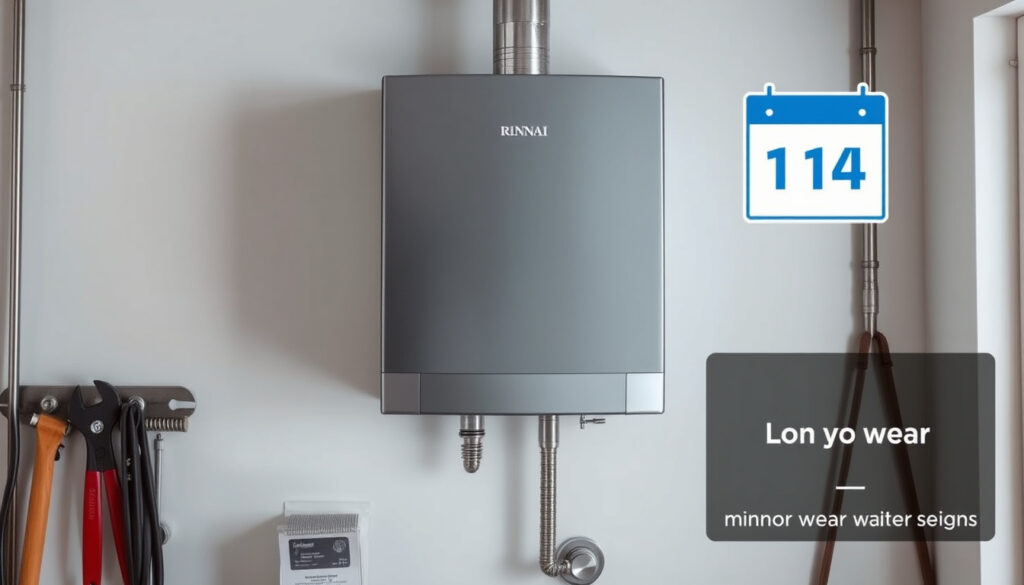
Rinnai Tankless Water Heater: Problems, Lifespan & Maintenance
If your Rinnai tankless water heater has ever flashed a cryptic error code or left you shivering mid-shower, you already know how quickly these units can become a headache. Rinnai’s on-demand systems demand a different kind of attention—regular maintenance and a basic understanding of what those codes mean. This guide walks you through the most common Rinnai problems, how long you can expect the unit to last, and exactly how to keep it running without calling a technician every few months.
Lifespan: Up to twice as long as tank heaters · Warranty: Twice the standard warranty · Energy Use: Heats only on demand · Fuel Options: Propane compatible · Maintenance: Annual flushing recommended
Quick snapshot
- Rinnai tankless units last up to 20 years with proper maintenance (Rinnai Tankless Water Heater Not Working? Common Problems)
- Rinnai recommends flushing annually with 4 gallons of undiluted white vinegar (Rinnai Official)
- Water supply pressure must be at least 30 PSI for proper operation (Rinnai Official PDF)
- Exact failure rates vary by installation quality and region
- Shower capacity depends heavily on incoming water temperature and model sizing
- Frequency of descaling may need adjustment in harder water areas beyond official guidance
- First DIY flush recommended after approximately 18 months following installation (Rinnai Flush Routine)
- Monthly cold inlet filter cleaning recommended by maintenance guides (Tommy Car Wash Systems)
- Annual professional maintenance suggested for units in hard water regions (Rinnai Flush Routine)
- Understanding error codes reduces service calls and extends unit life
- Regular flushing prevents heat exchanger damage—a costly repair
- Proper sizing ensures adequate hot water for simultaneous fixture use
The specifications below summarize key technical details from official Rinnai documentation and model listings.
| Specification | Details |
|---|---|
| Type | Condensing tankless gas |
| Fuel | Natural gas or propane |
| Key Models | RXP199iN and N1300 series |
| Notable Features | Hydrogen blend ready |
| Water Pressure Minimum | 30 PSI |
| Flushing Solution | 4 gallons undiluted white vinegar |
What are common problems with Rinnai water heaters?
Rinnai tankless units are generally reliable, but when problems arise, they typically fall into a handful of predictable categories. Understanding these patterns helps you diagnose issues faster and decide whether a DIY fix or professional call is warranted.
Error codes and beeping issues
Error codes on Rinnai units serve as diagnostic signals, and some appear far more frequently than others. Error Code 11 indicates an ignition failure—it typically stems from gas supply issues, low gas pressure, or air trapped in the gas lines, according to High Ground Service Pros (specialized HVAC technicians). The fix usually involves checking that the gas valve is fully open, inspecting gas lines for kinks, purging any air from the lines, and ensuring proper ventilation.
Error Code 16, common on older Rinnai models, signals an over-temperature warning. This means you should check for airflow restrictions, verify water flow isn’t too low, inspect for foreign materials in the burner, or examine whether the heat exchanger has become clogged, as noted by Big Frog Supply (specialty plumbing retailer). Error Code 03 indicates a power interruption during bath fill and can often be resolved by pressing the ON/OFF button twice, per Rinnai’s official diagnostic codes PDF. If the code persists after three resets, the PC Board likely needs replacement.
Persistent error codes after basic troubleshooting—particularly codes 11, 12, or 16—typically warrant a service call. Gas-related issues in particular are not DIY territory unless you have proper certifications.
Most common tankless problems
Beyond error codes, several root-cause issues drive most Rinnai failures. Insufficient gas supply, closed valves, tripped breakers, clogged water filters, and scale buildup rank among the most frequent reasons for no hot water, according to Total Home Supply Blog (specialty water heater retailer). Water temperature fluctuations often indicate that the unit’s capacity is being exceeded, settings are configured incorrectly, or scale has accumulated inside the heat exchanger.
Scale buildup deserves special attention because it progressively erodes heat exchanger walls over time. The Rinnai Official guidance emphasizes that mineral accumulation not only reduces efficiency but can ultimately destroy the heat exchanger—a repair that typically costs more than the original unit. In hard water regions, this risk is substantially elevated, making regular flushing not optional but essential.
How long will a Rinnai tankless water heater last?
Rinnai tankless water heaters are engineered for longevity—often lasting up to twice as long as conventional tank-style units, according to Rinnai’s official product literature. With proper maintenance, some units reportedly operate for 20 years or more.
Lifespan factors
Several variables determine how long your specific Rinnai will last. Water quality ranks at the top—hard water areas accelerate mineral scaling, which directly shortens the unit’s functional lifespan unless proactive descaling is performed. Installation quality matters significantly: proper gas line sizing, adequate ventilation, and correct water pressure (minimum 30 PSI, per Rinnai’s diagnostic documentation) ensure the unit operates within design parameters. Usage patterns also play a role—frequent high-volume draws put more stress on components than light residential use.
Warranty details
Rinnai backs its tankless units with warranties that typically run twice the standard coverage offered by competing brands. The specific terms vary by model and registration status, but residential units generally include comprehensive heat exchanger coverage extending 12–15 years and parts coverage for 5–10 years. Registering your unit promptly and keeping maintenance records are essential for honoring warranty claims.
What this means: the upfront investment in a Rinnai tankless heater carries lower long-term ownership risk than cheaper alternatives, but only if you maintain it. Skipping annual flushing effectively voids the implicit bargain of that extended warranty.
How often should you flush your Rinnai tankless water heater?
Rinnai’s official recommendation is clear: flush your tankless water heater at least once per year using 4 gallons of undiluted white vinegar. This removes mineral buildup before it damages the heat exchanger, according to Rinnai’s official flushing guide. Some third-party maintenance guides suggest more frequent intervals—every six months—for areas with particularly hard water.
Flushing frequency
The standard annual flush aligns with Rinnai’s factory guidance and satisfies warranty requirements for most installations. However, if your local water supply exceeds 120 mg/L of mineral content (classified as moderately hard to very hard), more frequent descaling makes financial sense. Units in hard water regions showing early warning signs—reduced flow rate, longer heat-up times, or occasional temperature fluctuations—may benefit from a twice-yearly schedule.
Signs it needs flushing
Watch for these indicators that your Rinnai needs attention: noticeably reduced water flow compared to when the unit was new, water taking longer to reach temperature, inconsistent temperatures during use, or error codes appearing more frequently. Any of these suggest scale has accumulated enough to affect performance. The Rinnai Official documentation warns explicitly against using chemical cleaning solutions—only undiluted white vinegar should be used to avoid health risks and potential damage to internal components.
How do I flush clean my Rinnai tankless water heater?
Flushing a Rinnai tankless water heater is a straightforward process that most homeowners can complete in under an hour with basic tools. Rinnai’s official procedure, documented on their website, forms the reliable foundation for this process.
Step-by-step flushing process
Begin by turning off power to the unit at the breaker, then shut off the gas. Close all three water valves—the hot water outlet, cold water inlet, and the bypass valve. Attach hoses to the purge valves: one from the pump outlet to the cold water inlet purge valve, and another from the pump inlet to the hot water outlet purge valve. Place the pump inlet hose into a container holding 4 gallons of undiluted white vinegar. Open the purge valves, activate the pump, and allow the solution to circulate through the system for approximately one hour at a flow rate of 4 GPM, according to maintenance guides from Tommy Car Wash Systems (industrial maintenance specialists). After completion, flush the system with fresh water to remove any residual vinegar before restoring normal operation.
Tools required
You’ll need a submersible pump (capable of 4 GPM flow), two reinforced hoses with hose clamps, a 5-gallon bucket, approximately 4 gallons of undiluted white vinegar, and basic hand tools for closing valves and making connections. A towel or drop cloth prevents water damage during the process. Rinnai explicitly warns against chemical cleaning solutions—white vinegar is the only approved descaling agent for safe DIY maintenance.
Monthly cold inlet filter cleaning—closing valves, rinsing screens, and reinstalling—is also recommended by maintenance professionals, adding a smaller recurring task to your ownership routine beyond the annual flush.
Can you run two showers with a tankless water heater?
Whether a Rinnai tankless unit can supply two simultaneous showers depends entirely on model sizing, incoming water temperature, and flow rate requirements. Undersized units will deliver lukewarm water or trigger error codes when pushed beyond their capacity.
Sizing for multiple fixtures
Tankless water heater capacity is measured in BTU output and maximum flow rate (gallons per minute). A single shower typically requires 2.0–2.5 GPM, while a full-size showerhead might demand 2.5 GPM or more. Larger Rinnai models like the RXP199iN can handle higher combined demands than compact series units. The rule of thumb: add up the flow rates of all fixtures you expect to run simultaneously and choose a model that exceeds that total by at least 20% to account for temperature rise requirements. For more information on this topic, check out Actualitzacions de la indústria de xips avui.
Rinnai model capacity
Rinnai’s residential lineup spans a range of capacities. The N1300 series handles moderate demands suitable for smaller households, while the RXP199iN targets higher-volume applications. Total Home Supply Blog notes that if you’re experiencing temperature fluctuations when running multiple fixtures, reducing simultaneous usage or upgrading to a higher-capacity model resolves the issue. Propane-compatible models offer equivalent performance to natural gas variants, making them viable for rural installations.
The trade-off: investing in a larger model costs more upfront but eliminates the frustration of running out of hot water during simultaneous use—a frustration that often drives owners to replace the unit prematurely with a larger model anyway.
This table compares specifications for the two Rinnai models most commonly discussed in residential installations.
| Specification | RXP199iN | N1300 Series |
|---|---|---|
| Fuel Type | Natural gas / Propane | Natural gas / Propane |
| Type | Condensing tankless gas | Non-condensing tankless gas |
| Typical Flow Rate | Up to 11 GPM | Up to 6.5 GPM |
| Temperature Rise at Max Flow | Varies by inlet temp | Varies by inlet temp |
| Key Feature | Hydrogen blend ready | Standard residential use |
Upsides
- On-demand hot water with no standby losses
- Lifespan up to 20 years with maintenance—double typical tank heaters
- Energy efficient: heats only when hot water is called
- Propane-compatible for off-grid or rural installations
- Compact wall-mount design saves floor space
- Extended warranties outpace most competitors
Downsides
- Higher upfront cost than tank alternatives
- Requires annual maintenance to maintain warranty and performance
- Scale buildup in hard water areas can destroy heat exchanger
- Simultaneous fixture demands may exceed smaller models
- Gas units require electricity for ignition and controls
- Professional installation recommended for gas connections
Performing annual maintenance on your Rinnai
Beyond the annual vinegar flush, a comprehensive Rinnai maintenance routine includes several smaller tasks. Monthly cold inlet filter cleaning involves closing valves, removing and rinsing the screen, and reinstalling it—a task taking under ten minutes, according to maintenance documentation. Inspection of venting connections, gas line integrity, and water line fittings should occur at least annually. Any signs of corrosion, rust, or moisture around connections warrant immediate professional attention.
- Turn off power and gas supply before any maintenance work
- Close all three water valves: hot outlet, cold inlet, and bypass
- Attach hoses to purge valves and connect to submersible pump
- Circulate 4 gallons of undiluted white vinegar for approximately one hour at 4 GPM
- Flush system with fresh water after vinegar circulation completes
- Reopen all valves and restore gas and power supply
- Verify normal operation by running hot water through a fixture
- Check for any error codes and confirm stable temperature output
For homeowners in hard water regions, the annual vinegar flush isn’t optional—it’s the difference between a 20-year unit and a 5-year replacement. Budget the hour it takes; your future self will thank you.
Use 4 gallons (15.1 liters) of undiluted white vinegar to clean your tankless water heater. Never use chemical solutions of any kind.
— Rinnai (Official Manufacturer)
47% of all tankless water heater failures stem from mineral buildup.
— Maintenance Industry Analysis (Video Expert)
Related reading: lbs to kg conversion · inch to cm conversion
Rinnai owners facing cold showers or error codes should explore water heater repair near me for expert diagnosis of hard water buildup and other faults.
Frequently asked questions
Why do plumbers sometimes not recommend tankless water heaters?
Some plumbers express reservations about tankless units because of the maintenance requirements and upfront cost. Traditional tank heaters require less frequent attention, making them simpler to support in rental properties or for landlords who prefer minimal involvement. Additionally, if hard water is present and flushing is neglected, tankless units can fail catastrophically—damaging the unit’s reputation and creating service headaches. However, for homeowners committed to maintenance, the long-term energy savings and extended lifespan typically justify the switch.
What is the most common problem with tankless water heaters?
Mineral scale accumulation ranks as the most frequent cause of tankless heater problems, accounting for a substantial portion of reported failures. This manifests as reduced flow rate, inconsistent temperatures, or complete unit shutdown. Regular flushing prevents this issue. Gas supply problems and ignition failures follow as second-tier concerns.
What does Rinnai tankless water heater beeping mean?
Rinnai units beep to alert you to error codes or operational status changes. A single beep often signals the unit cycling on or off normally. Repeated beeping patterns, however, indicate specific error codes. Error Code 03, for example, means power was interrupted during a bath fill operation. Check your unit’s display panel and refer to the error code reference to identify the specific issue triggering the alert.
Is there a Rinnai tankless water heater app?
Rinnai offers smart connectivity features for select models, allowing monitoring and basic control via smartphone applications. These apps enable homeowners to track operational status, receive maintenance reminders, and adjust settings remotely. Availability varies by model and market, so check Rinnai’s current offerings for your specific unit.
What does the Rinnai tankless water heater manual cover?
The official Rinnai manual covers installation requirements, error code definitions, maintenance schedules, troubleshooting procedures, warranty terms, and safety warnings. Access to your specific model’s manual (available from Rinnai’s official website) is essential for proper setup and ongoing operation.
How do I read Rinnai tankless water heater error codes?
Error codes display on the unit’s front panel as numbers (e.g., Code 11, Code 16). Rinnai’s official diagnostic codes PDF provides the complete code list with definitions and recommended actions. Keep this reference accessible near your unit for quick reference during error events.
Homeowners who skip the annual vinegar flush risk destroying their heat exchanger early, forcing a replacement that costs more than the original investment in the unit.
More related posts
 Kali Uchis: Biography, Ethnicity, Family, and More
 Cast of Daisy Jones and the Six: Actors & Characters Guide
 Canadian Visitor Visa 2026: Requirements, Times & New Rules
 Gary Burghoff: Life, Career, and Relationship with Alan Alda
 Amazon Canada Promo Code: How to Find Discounts
 Cass Elliot: Biography, Daughter, and Death Myths Debunked
 Ben Affleck: Divorce, Health, Height & 2025 Updates
 Raptors vs Celtics Match Player Stats: Dec 7, 2025 Game