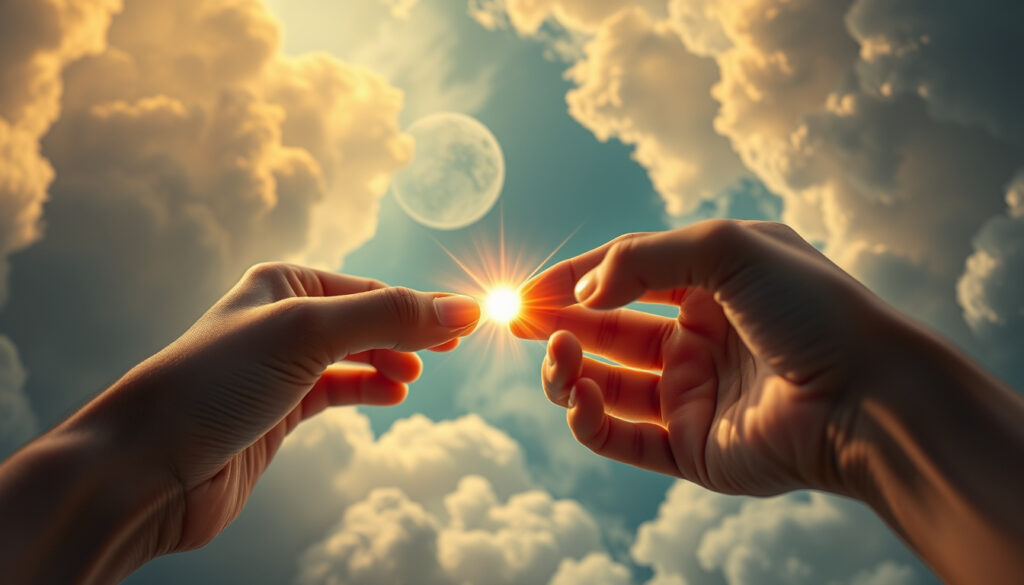
The Creation of Adam: Meaning, Hands & Controversies
You have probably seen the image countless times — God and Adam, fingertips almost meeting, suspended in a gap that somehow feels more electric than any full touch. That near-contact, painted by Michelangelo on the Sistine Chapel ceiling between 1508 and 1512, has inspired billions of reproductions and countless theories about what the Renaissance master was really saying. What fewer people realize is how much controversy simmers beneath that iconic composition: anatomical secrets, theological deviations, and questions about Michelangelo’s personal life that scholars are still debating today.
Artist: Michelangelo · Location: Sistine Chapel Ceiling · Biblical Source: Genesis 1:26-27 · Medium: Fresco · Commissioned By: Pope Julius II
Quick snapshot
- Whether God’s cloud intentionally resembles a human brain (Clinsights Substack)
- Whether Michelangelo hid a self-portrait in God’s figure (Artnet)
- Whether anatomical details are deliberate subversions or coincidental (BiblicalTheology.com)
- 1505: Pope Julius II summons Michelangelo from Florence to Rome
- 1508–1512: Painting period of the Sistine Chapel ceiling
- November 1, 1512: Public unveiling of the ceiling
- Continued scholarship on hidden anatomical imagery
- Ongoing debates about Michelangelo’s personal beliefs and sexuality
- Visitors to the Vatican can still see the fresco in person (photos prohibited)
These specifications outline the essential parameters of one of history’s most significant religious artworks.
| Fact | Detail |
|---|---|
| Artist | Michelangelo Buonarroti |
| Date | c. 1508–1512 |
| Location | Sistine Chapel, Vatican |
| Dimensions | Approx. 280 cm × 570 cm |
| Subject | God creating Adam |
What was the meaning behind The Creation of Adam?
On its surface, the fresco illustrates a straightforward biblical scene: God breathing life into Adam, the first man, as described in Genesis 1:26 — “Then God said, ‘Let Us make man in Our image, after Our likeness.'” (The Collector). The painting is the fourth panel in the larger Genesis series that covers the Sistine Chapel ceiling, commissioned by Pope Julius II and completed between 1508 and 1512 (Wikipedia).
Biblical Interpretation
The official meaning aligns with Catholic doctrine: God creates man in His divine image, bestowing life and consciousness upon Adam. Unlike earlier medieval depictions that showed God physically reaching down to touch Adam, Michelangelo chose to render the moment of almost-contact — fingers separated by a hairline gap that has captivated viewers for five centuries (ItalianRenaissance.org). This gap, art historians argue, represents the spark of life itself: the precise moment between inertness and animation.
Michelangelo’s Artistic Choices
Michelangelo painted the Sistine ceiling almost entirely alone, without the studio assistants that most Renaissance painters relied upon (KUURTH). He worked lying on his back on scaffolding for years, producing verses complaining of physical agony — “My haunches are grinding into my guts, my poor ass strains to work as a counterweight” (Artnet). Yet the final composition appears effortless: Adam lounges in a contrapposto pose that echoes God’s dynamic, forward-reaching posture, suggesting not just physical similarity but shared divine essence (ItalianRenaissance.org).
The implication: Michelangelo balanced biblical fidelity with artistic innovation, embedding layers of meaning that rewards close study.
Why don’t the fingers touch in The Creation of Adam?
The near-touch is the painting’s defining tension. God’s finger extends downward; Adam’s hand rises toward it — but the space between remains unbroken. Scholars have long interpreted this gap as the moment before life, the threshold between divine and mortal (The Collector). It creates dramatic suspense while also allowing Michelangelo to suggest the nature of creation itself: a spark, not a push.
Symbolic Gap
The gap carries theological weight. If God’s finger fully touched Adam’s, the act of creation would feel complete, mechanical — a transaction. Instead, the near-touch leaves the viewer suspended in the moment of potential. Some analysts argue this reflects Neoplatonic philosophy popular among Renaissance humanists: the soul (or life force) cannot be given mechanically but must be received, meeting halfway between divine will and human readiness (Clinsights Substack).
Artistic Technique
Michelangelo’s arrangement serves compositional purposes too. The outstretched arms create diagonal energy across the canvas, drawing the eye from bottom-left (Adam) to top-right (God). Adam’s concave, reclining form mirrors God’s convex, forward-bursting posture — a visual rhyme that the figures are made for each other (ItalianRenaissance.org). The finger gap intensifies this dynamic: it freezes the composition at peak tension, preventing the eye from “completing” the image and moving on.
The gap that seems like an absence is actually the painting’s most powerful presence. A fully completed touch would be forgettable; the almost-touch is unforgettable.
What this means: The near-touch transforms a simple biblical illustration into a meditation on creation itself.
Why is The Creation of Adam painting controversial?
Here is where Michelangelo’s masterpiece becomes genuinely complicated. Far from a straightforward Bible illustration, the fresco reportedly contains hidden anatomical imagery that some scholars say challenges Catholic doctrine or reflects the artist’s personal philosophy.
Interpretations of Anatomy
In 2013, researchers published a study noting that the shroud or cloud surrounding God’s figure closely resembles the anatomical shape of a human brain — complete with a frontal lobe, pituitary gland, and optic nerve (BiblicalTheology.com PDF). The same analysis suggests God’s red cloak forms the outline of a womb, with His extended arm functioning as an umbilical cord (The Collector). If intentional, these details would suggest Michelangelo meant to depict not just the creation of physical life but the gift of intelligence and creative potential — making Adam an artist in God’s image, not merely a passive recipient of breath.
Art historian Adriano Marinazzo has gone further, theorizing that God’s face is actually a self-portrait of Michelangelo himself, based on the artist’s own sonnets from 1509–1511 (Artnet). These poems describe physical agony during the painting process — “every gesture I make is blind and aimless” — and Marinazzo argues that portraying oneself as God was Michelangelo’s way of claiming divine authority over his own creative act.
Michelangelo’s Influences
Other anatomical details raise theological questions. Art historians have noted that Adam appears to have an extra rib — a detail that, if intentional, would suggest Michelangelo knew and perhaps agreed with the Kabbalistic text known as the Zohar, which describes the original creation as simultaneously male-and-female before the split into two separate beings (Parsons ADHT). Catholic tradition holds that Eve was created from Adam’s rib after he was already formed — a sequence the fresco’s extra rib would quietly contradict. Additionally, the background behind God reportedly shows an anatomically correct brain structure, with God’s arm reaching through the prefrontal cortex — the seat of imagination (Clinsights Substack).
These anatomical theories remain debated. Critics argue that pattern-matching in visual art often leads viewers to “find” shapes that were never deliberately placed. The burden of proof lies with those claiming intentional anatomical coding — and it has not been definitively met.
Was Michelangelo LGBTQ?
This question has simmered in art history for decades, based partly on Michelangelo’s famously passionate relationships with young male artists and patrons, and partly on subtext allegedly embedded in his work. The question is legitimate scholarship, not sensationalism — but definitive answers remain elusive.
Relationships
Michelangelo wrote love poetry — explicitly romantic and physical — to several young men, most famously the aristocrat Tommaso dei Cavalieri, whom he addressed with declarations like “I have not yet achieved the fire I feel in my heart” (Wikipedia). These sonnets were not private metaphors but circulated publicly in Renaissance Italy, where such expression occupied a complicated cultural space between the platonic and the physical. Renaissance sexuality did not map neatly onto modern categories, and scholars disagree about how to classify Michelangelo’s attractions.
Artistic Expressions
What seems more certain is that Michelangelo embedded personal meaning into his religious works in ways his patrons may not have fully recognized. The self-portrait theory linking God’s face to Michelangelo’s own, combined with his anatomical self-confidence throughout the Sistine ceiling, suggests an artist comfortable claiming divine authority — whether that reflects sexual identity, artistic ego, or Renaissance humanist philosophy is genuinely unclear. The Zohar-influenced rib detail, if deliberate, could be read as a quiet theological rebellion or simply as an artist showing off his anatomical knowledge (Parsons ADHT).
“My haunches are grinding into my guts, my poor ass strains to work as a counterweight, every gesture I make is blind and aimless.”
— Michelangelo, sonnet written during Sistine Chapel ceiling painting, 1509–1511 (Artnet)
The pattern: Michelangelo’s personal anguish and artistic vision intertwined, suggesting his physical suffering shaped the divine authority he claimed in his work.
Why are no photos allowed in Sistine Chapel?
Millions of visitors a year stream through the Sistine Chapel, and almost all are surprised to find that photography — including phone cameras — is prohibited. The prohibition is not arbitrary; it reflects genuine conservation concerns for one of the world’s most valuable cultural assets.
Preservation Reasons
The frescoes on the Sistine Chapel ceiling are 500 years old and remain fragile despite their fame. Flash photography, in particular, generates heat and light exposure that can accelerate pigment fading in delicate areas. While modern smartphone cameras are far less destructive than professional flash equipment, the Vatican estimates that cumulative visitor photography — hundreds of thousands of images per year — creates measurable risk to the work’s longevity. The Sistine Chapel is enclosed, humidified space with limited air circulation, meaning any temperature or humidity fluctuations from equipment have nowhere to dissipate (KUURTH).
Visitor Rules
The Vatican enforces photography bans through museum staff who monitor the Chapel space. Visitors who attempt to photograph are typically asked to stop; persistent violations can result in removal from the premises. The rule also serves a quieter purpose: it maintains the reverence of the space. Unlike a museum where visitors casually photograph everything, the Sistine Chapel retains something of a liturgical atmosphere — a reminder that it remains a functioning place of worship within the Apostolic Palace complex, not merely a tourist attraction.
The implication: Protection measures, while restrictive, paradoxically enhance the fresco’s mystique and reverence.
What scholars say
“God is offering to make Adam an artist; a creator, ‘in His image.'”
— Art analyst Clinsights, interpreting Michelangelo’s anatomical symbolism (Clinsights Substack)
“The Kingdom of Heaven is within you.”
— Clinsights, on Michelangelo’s Neoplatonic interpretation of the divine spark (Clinsights Substack)
What we know — and what we don’t
Confirmed
- The Creation of Adam is a fresco painted by Michelangelo on the Sistine Chapel ceiling, completed between 1508 and 1512
- The fresco depicts God giving life to Adam, drawing from Genesis 1:26–27
- It is the fourth panel in the Genesis series commissioned by Pope Julius II
- Michelangelo painted the ceiling essentially alone, despite immense physical toll documented in his sonnets
- The near-touch of fingers creates the painting’s iconic tension and meaning
Unconfirmed
- Whether the brain, womb, or rib imagery was intentional anatomical coding or coincidental pattern recognition
- Whether God’s figure is a self-portrait of Michelangelo
- How much Zohar-influenced Kabbalah actually influenced Michelangelo’s theological choices
- The precise unveiling date of November 1, 1512 (source verification remains limited)
- Whether anatomical details reflect the artist’s personal beliefs, professional pride, or deliberate subversion
Related reading: song meaning analysis
Frequently asked questions
What is The Creation of Adam?
The Creation of Adam is a fresco painted by Michelangelo Buonarroti between 1508 and 1512, depicting the biblical moment when God breathes life into Adam. It covers approximately 280 cm × 570 cm on the Sistine Chapel ceiling in Vatican City.
Where is The Creation of Adam located?
The fresco is located on the ceiling of the Sistine Chapel, which sits within the Apostolic Palace in Vatican City. Visitors can view it in person during standard Vatican Museums hours.
Who commissioned The Creation of Adam?
Pope Julius II commissioned the Sistine Chapel ceiling — including The Creation of Adam — after summoning Michelangelo from Florence to Rome in 1505. The ceiling was publicly unveiled on November 1, 1512.
What does The Creation of Adam depict?
The fresco illustrates Genesis 1:26–27: God creating the first man, Adam, in His divine image. The composition features two figures — a lounging Adam below and a dynamic, cloak-wrapped God above — separated by a narrow gap between their outstretched fingers.
When was The Creation of Adam painted?
Michelangelo painted the fresco between 1508 and 1512, working nearly alone on scaffolding for four years. He completed the entire Sistine Chapel ceiling — nine central panels plus surrounding figures — during this period.
What is the significance of the hands in The Creation of Adam?
The outstretched hands are the painting’s emotional and theological core. The near-touch — fingers almost but not quite meeting — represents the moment between inertness and life, the spark of divine consciousness. Scholars interpret the gap as both an artistic device creating visual tension and a theological statement about the nature of creation.
How can I see The Creation of Adam?
The fresco is permanently displayed on the Sistine Chapel ceiling in Vatican City. Tickets to the Vatican Museums grant access to the Chapel. Photography is prohibited inside the Chapel to protect the 500-year-old frescoes from flash damage.
More related posts
 First Nations Border Crossing Warning: New Passport Advice
 Will Bo Bichette Play in the World Series? Roster Update
 Best Parrillada Argentina Near Me – Authentic Providence Guide
 Bambu Lab A1 Mini – Specs, Review, Setup Guide
 First Aid Training Calgary – Courses Costs Providers Guide
 Lbs to Kg Conversion – Formula, Chart and Calculator
 How to Start Blog Simplyseven Net: Login & App Guide
 Crew Collective & Cafe Menu – Items Hours 2024